


Using Fully Autonomous Robots to Disinfect Public Transit Assets
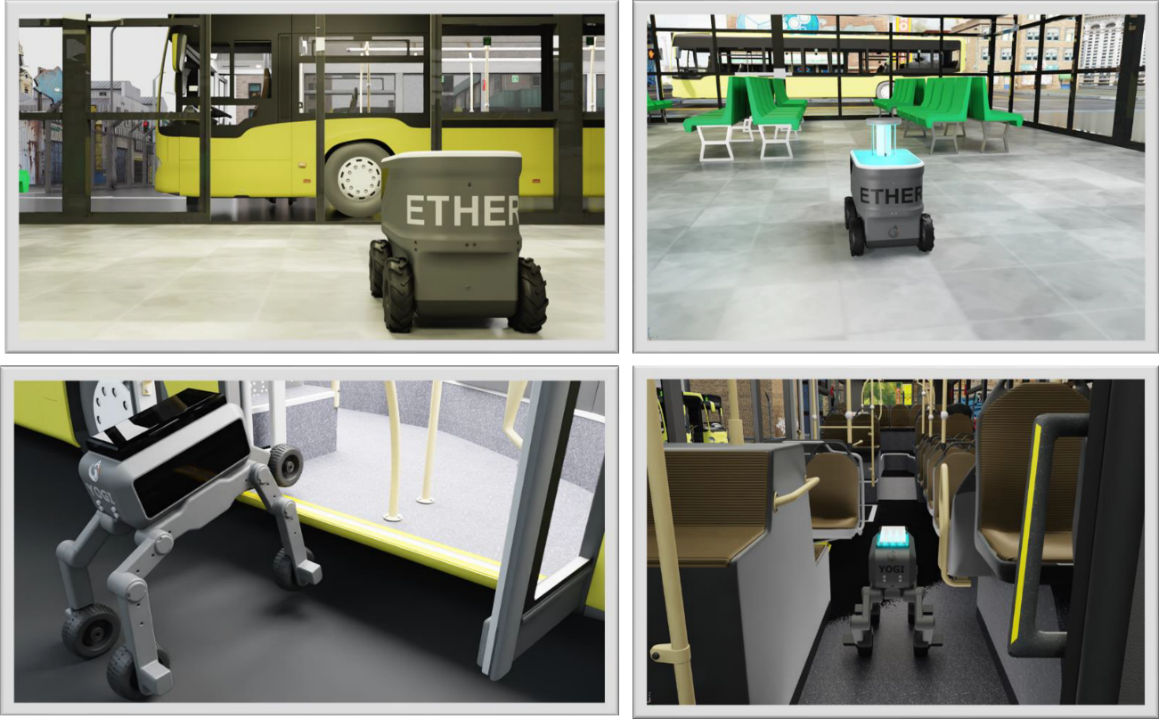
Bottom: Yogi-Bot™ steps onto a bus and maneuvers down the aisle.
(Source: Advent Innovations)
U.S. Transportation Secretary Sean Duffy recently identified improvements to public transportation public safety as a critical priority. There is a critical need for improved and efficient public transportation sanitation processes to maintain a high level of public safety and slow disease transmission. Funding provided by FTA through U.S. DOT’s Small Business Innovation Research (SBIR) program allowed Advent Innovations to further develop its robotics technology to disinfect transit assets while also boosting its visibility in the commercial market.
The Challenge
Public transit vehicle and station sanitation are important to maintaining a healthy and welcoming public transportation system. While daily maintenance and cleaning of public transit vehicles are vital, they can be costly. Manual cleaning is expensive, physically demanding, and increases risk of exposure to disease and health hazards for personnel and passengers.
The Technology
Advent Innovations, a women-owned small business, developed robotic cleaning machines that reduce time, effort, and costs of traditional manual cleaning methods. Advent Innovations developed two robots, the Yogi-Bot™ and Ether-Bot™, that can disinfect transit vehicles and stations, reducing the manual labor required to maintain these facilities. Yogi-Bot™ is designed to clean the inside of transit vehicles. Ether-Bot™ is designed to clean large areas such as transit centers. Both robots are equipped with liquid disinfectants and other cleaning methods such as UV-C lamps, allowing them to sanitize a wide variety of transit vehicles and infrastructure.
According to Advent Innovations, the first end users would be transit agency janitorial staff who currently do manual sanitation in transit stations, buses, and trains. Using these robots, janitorial staff will have new tools to safely and efficiently deliver clean and safe transit systems.
SBIR’s Role
Funding provided by FTA through the SBIR program helped Advent Innovations take their AI-powered robotic cleaning machines to the next level. “Our local transit agencies and the South Carolina Department of Education are interested in pilot testing the robots,” said Dr. Ritubarna Banerjee, President, Advent Innovations. She noted that the SBIR award has helped make Advent Innovations more visible in the disinfection robotics market in the U.S.
The Future
Advent Innovations is currently meeting with transit agencies to explore pilot testing opportunities and aims to reach commercial viability by providing innovative sanitation solutions for transit providers. After pilot testing, Advent Innovations’ goal is mass production for moderate-sized transit agencies. Although the technologies are targeted toward public transit agencies, the small business envisions expanding to schools and airport facilities.
About the U.S. DOT SBIR Program
The U.S. DOT Small Business Innovation Research (SBIR) program awards over $10 million annually to small businesses to enable research on and development of innovative solutions to our nation’s transportation challenges. The highly competitive program encourages small businesses to explore their technological potential and provides the incentive to profit from its commercialization. Small businesses that participate in the SBIR program have developed numerous new and innovative technologies that have benefited U.S. DOT and the public, while providing a basis for growth for small businesses. The U.S. DOT Volpe Center administers the SBIR program on behalf of U.S. DOT and partners with funding operating administrations and small businesses alike in working toward a successful outcome that can benefit the nation’s transportation system. Learn more at www.volpe.dot.gov/work-with-us/small-business-innovation-research.
About the U.S. DOT Volpe Center
Since 1970, the U.S. DOT Volpe Center has advanced transportation innovation for the public good, providing multimodal applied research, collaborating with federal, state, and industry partners, and multidisciplinary technical leadership and expertise to solve complex transportation challenges. Learn more at www.volpe.dot.gov.