


Using AI-Powered Camera Technology to Improve Grade Crossing Safety
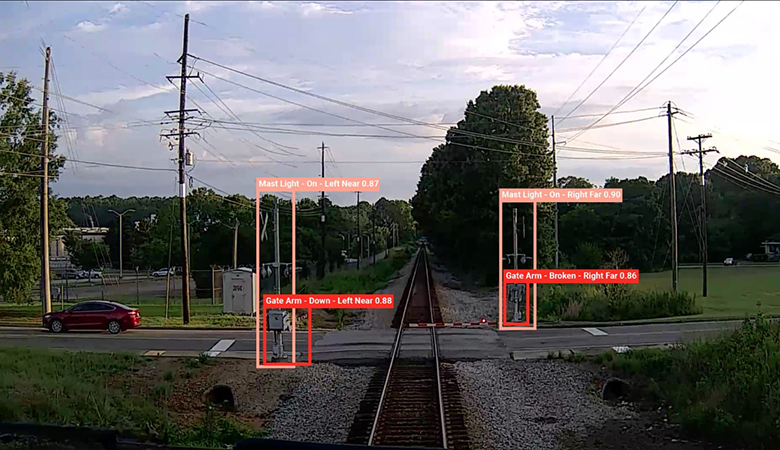
Rail grade crossings are intersections where roadways cross railroad tracks at-grade. Trespassing along railroad rights-of-way is the leading cause of rail-related deaths in the United States each year. Wi-Tronix received funding from FRA through U.S. DOT’s Small Business Innovation Research (SBIR) program to develop AI-powered camera technology to address railroad crossing safety and improve trespass prevention.
The Challenge
In many places around the U.S., railroad tracks intersect local roads used by vehicles and pedestrians, some in densely populated communities. This can set the stage for deadly conflict with pedestrians and vehicles. Since trains are heavy, taking upwards of one mile to stop, the risk of deadly rail-related strikes is higher when people trespass onto the tracks.
With more than 200,000 grade crossings in the U.S., understanding and preventing railroad crossing incidents and trespassing events is a major safety concern for both FRA and FHWA. According to FRA, more than 500 people die every year in railroad trespassing events.
The Technology
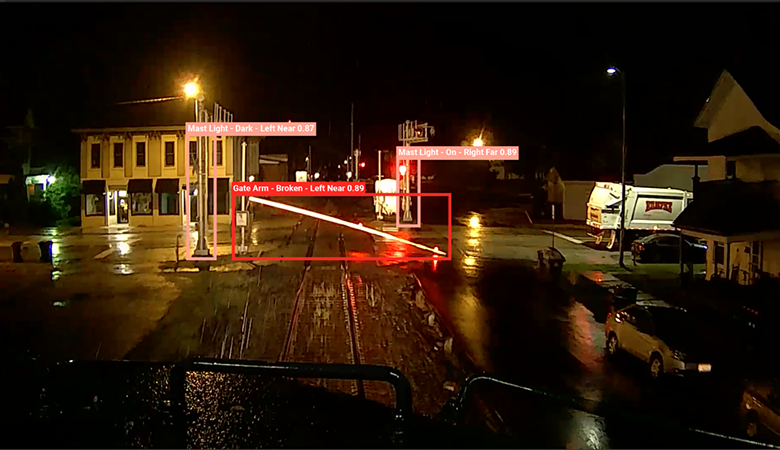
Wi-Tronix, a small business focused on real-time rail safety data and analytics, received funding from FRA through U.S. DOT’s SBIR program to develop automated technology for inspecting railroad crossing infrastructure using AI technology. According to FRA data, a little more than half of public highway-rail grade crossings in the U.S. feature “active” warning devices, such as automated gates or flashing lights. These devices currently undergo manual inspections, which are labor intensive and typically happen monthly. Wi-Tronix’s innovative technology performs automatic daily inspections, allowing for earlier detection of issues. Wi-Tronix leveraged front-facing cameras already installed on many locomotives to gather video data of grade crossings and uses that data to train AI models to recognize and classify whether railroad crossing features—like gates or flashers—are in working condition or have failed. The AI system alerts authorized railroad users to problems with crossing equipment that could lead to serious safety issues.
Wi-Tronix partnered with rail operator Brightline on a competitive Consolidated Rail Infrastructure and Safety Improvements (CRISI) grant from FRA to detect and analyze pedestrian trespassing events. This allows Brightline to identify which areas should be prioritized for safety improvements. Ritu Chawla, Wi-Tronix’s Director of Artificial Intelligence, noted that railroads can combat trespassing by figuring out where they should apply “corrective actions” to reduce trespassing, such as providing additional education, engineering physical barriers including fencing, or applying greater enforcement.
“It’s critical to develop technology that can detect near-miss events to gather broader and more accurate information about where dangerous areas are located,” said Chawla. “Gathering near-miss data also allows railroads to make safety interventions proactively—without having to wait for fatalities to happen first.”
Chawla shared that the trespasser detection technology the company is developing through the CRISI grant builds off the same data-gathering technology Wi-Tronix originally developed during its SBIR award. The key to solving both the SBIR challenge of detecting failed infrastructure and the CRISI challenge of detecting trespassing events is getting enough video data to train the AI system to accurately recognize these scenarios. Gathering data is particularly challenging for rare events like pedestrians trespassing in front of trains.
To solve this data-gathering problem, Wi-Tronix’s continuously improving onboard platform detects hundreds of locomotive signals in real-time, providing the ability to identify an abnormal event. By identifying these events, Wi-Tronix can standardize reporting of near-miss situations that risk not being manually reported by engineers due to stress, fatigue, or other emotional states. Once the AI system can accurately detect trespassing, Wi-Tronix customers can analyze which areas of the corridor have the most trespassing events so that they can prioritize installing fences or other interventions.
SBIR’s Role
With funding received from FRA through the SBIR program, Wi-Tronix advanced its smart data collection and other AI-enabled techniques as well as camera technology to be able to see farther ahead of the train. In addition to the technological advances, Chawla says that SBIR has played an important role in helping the small business navigate the world of rail transportation operations. “There’s more value than just funding. We got feedback through interactions with the experts to better understand the regulations and railroad operations,” she said.
The Future
Wi-Tronix is scaling up its SBIR research on grade crossings and will soon be able to inspect gate arms at around 8,000 crossings. Since Wi-Tronix’s SBIR research was piloted on 50 grade crossings, inspecting 8,000 crossings requires enhancements to enable AI predictions on a much larger data load. Wi-Tronix is also re-training AI models to recognize infrastructure elements in a wide variety of scenery and locations across the country. Wi-Tronix plans to use its active learning pipeline to maintain the model performance.
About the U.S. DOT SBIR Program
The U.S. DOT Small Business Innovation Research (SBIR) program awards over $10 million annually to small businesses to enable research on and development of innovative solutions to our nation’s transportation challenges. The highly competitive program encourages small businesses to explore their technological potential and provides the incentive to profit from its commercialization. Small businesses that participate in the SBIR program have developed numerous new and innovative technologies that have benefited U.S. DOT and the public, while providing a basis for growth for small businesses. The U.S. DOT Volpe Center administers the SBIR program on behalf of U.S. DOT and partners with funding operating administrations and small businesses alike in working toward a successful outcome that can benefit the nation’s transportation system. Learn more at www.volpe.dot.gov/work-with-us/small-business-innovation-research.
About the U.S. DOT Volpe Center
Since 1970, the U.S. DOT Volpe Center has advanced transportation innovation for the public good, providing multimodal applied research, collaborating with federal, state, and industry partners, and multidisciplinary technical leadership and expertise to solve complex transportation challenges. Learn more at www.volpe.dot.gov.