


Taking Urban Air Mobility Noise Modeling and Analysis to New Heights
A NASA study estimates that by 2030, a significant number of new air vehicles will be operating to support Urban Air Mobility (UAM). UAM vehicles will vary in size, speed, and configuration depending on their purpose and may be used for public transportation, cargo delivery, air taxi services, and more.
Many of these new air vehicles are designed to be quieter than traditional aircraft and helicopters and should be modeled as their own unique form of air transportation with UAM-specific data. FAA requires the use of the Aviation Environmental Design Tool (AEDT) for all noise, fuel burn, and emissions modeling for FAA actions under the National Environmental Policy Act, as well as for other FAA-approved studies, such as those under 14 CFR Part 150 and Part 161.
In June 2025, President Trump issued Executive Order 14307, Unleashing American Drone Dominance, which aims to accelerate the commercialization of unmanned aircraft systems in the National Airspace System (NAS).
Before these new air traffic vehicles can be deployed, however, accurate tools and metrics are needed to assess community noise impacts and avoid complaints that could limit the growth of UAM operations.
The U.S. DOT Volpe Center possesses extensive expertise in aircraft noise modeling, performance modeling, data and software development, and in the overall use of FAA’s AEDT aircraft modeling system.
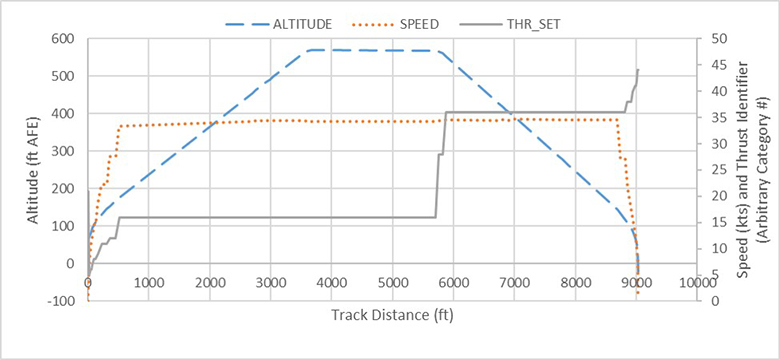
Recently, NASA’s Langley Research Center developed noise source data and flight profiles for multiple UAM vehicles and has modeled noise exposure in their own models for various scenarios. NASA and the U.S. DOT Volpe Center evaluated AEDT’s ability to model noise from UAM operations, identified potential shortcomings, and made recommendations to improve near-term UAM modeling.
U.S. DOT Volpe Center experts developed custom queries to import modeling data, helped troubleshoot technical issues, and analyzed unexpected modeling results. The team also provided feedback on NASA presentations and documents comparing alternative methods for modeling UAM in AEDT, including airplane, helicopter, and hybrid options.
Ultimately, the results of NASA and the U.S. DOT Volpe Center’s analyses informed feature improvements that are slated to be included in future releases of FAA’s AEDT. These updates bolster U.S. DOT’s mission to support the efficient and safe introduction of new air technologies into the NAS.
In 2025, the Volpe Center team was recognized for their noise and aircraft performance modeling contributions as members of a team receiving a NASA Group Achievement Award for UAM operational fleet noise assessment. The prestigious NASA Group Achievement Award recognizes an outstanding group accomplishment that has contributed substantially to NASA’s mission.
About the U.S. DOT Volpe Center
Since 1970, the U.S. DOT Volpe Center has advanced transportation innovation for the public good, providing multimodal applied research, collaborating with federal, state, and industry partners, and multidisciplinary technical leadership and expertise to solve complex transportation challenges. Learn more at www.volpe.dot.gov.